Ethereum is winning the scalability race — but is ETH losing the economic battle?
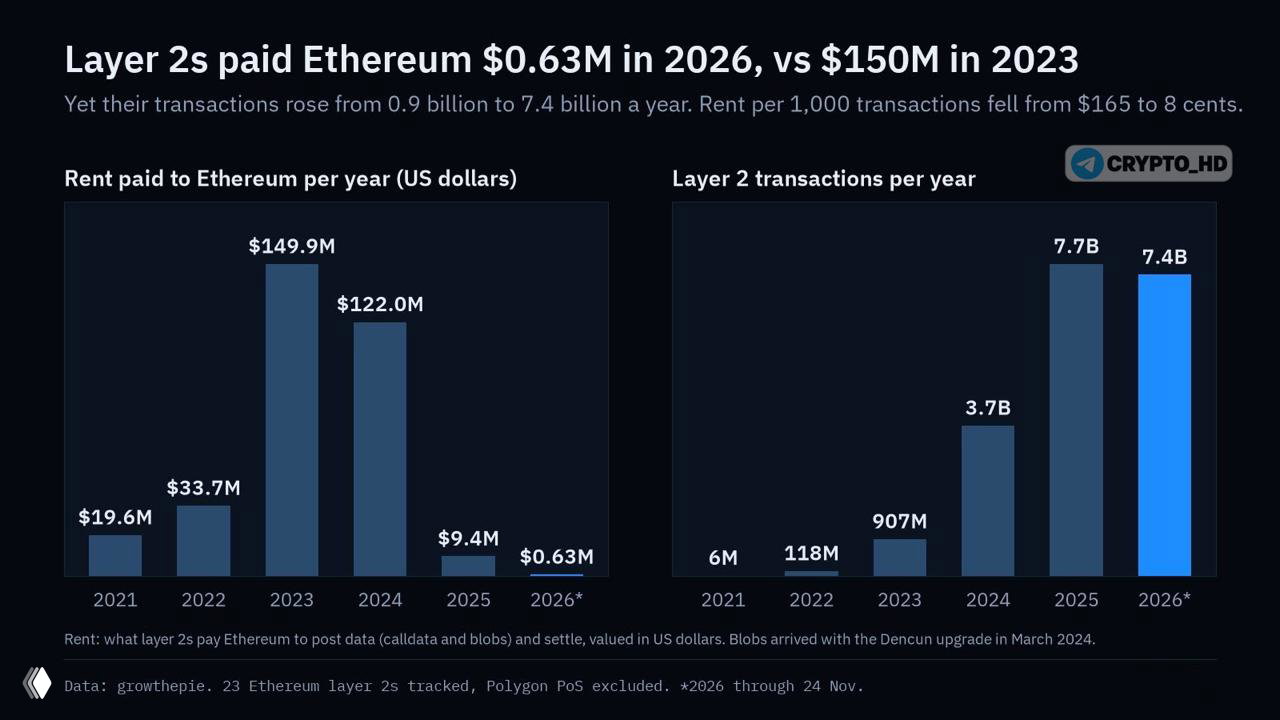
Since 2023, Layer 2 transaction volumes have surged more than 8x, while fees paid to Ethereum have collapsed by 99.6%.
- ➤ 2023: 907M transactions — $150M in fees.
- ➤ 2026: 7.4B transactions — just $630K in fees (through Nov. 24).
The Dencun upgrade in March 2024 fundamentally transformed Ethereum’s economics. By introducing blobs, Ethereum dramatically reduced L2 operating costs.
Fees per 1,000 L2 transactions plunged from $165 to $0.08 — a decline of over 99.9%.
Is this bullish or bearish for ETH?
🟢 The bullish scenario:
- • Lower transaction costs accelerate global blockchain adoption.
- • Ethereum strengthens its position as a global settlement layer.
- • Stablecoins, institutional DeFi and RWA tokenization create new demand for ETH.
🔴 The bearish scenario:
- • L2 operators retain more economic value.
- • Lower fees potentially weaken ETH’s burning mechanism.
- • Ecosystem growth no longer translates directly into base-layer revenue growth.
For investors, network adoption alone is no longer a sufficient valuation metric. Economic value capture matters.
Ethereum has proven it can scale technologically. Now it must prove it can scale economically.
Can Ethereum become the backbone of global on-chain finance while delivering sustainable value to ETH holders?
#Ethereum #ETH #Layer2 #DeFi #RWA #Tokenomics