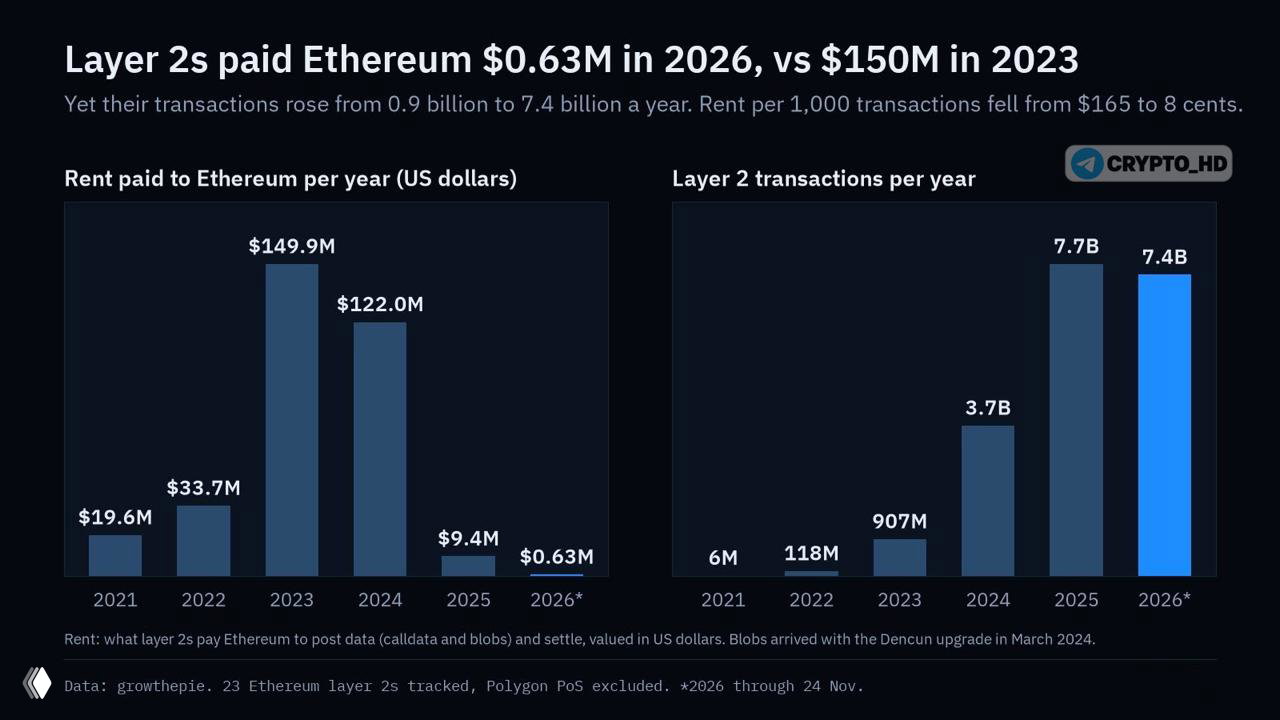
Ethereum’s scaling strategy is delivering remarkable results in terms of network adoption. However, its economic consequences raise important questions about ETH’s long-term value proposition. Since 2023, annual transaction volume across Ethereum’s Layer 2 (L2) networks has increased more than eightfold, while the fees these networks pay to Ethereum have collapsed by 99.6%. What happened?
The turning point was Ethereum’s Dencun upgrade in March 2024, which introduced EIP-4844 and a new data storage mechanism known as blobs. This innovation dramatically reduced the cost of publishing Layer 2 transaction data to Ethereum, making blockchain transactions significantly more affordable and scalable.
However, this technological achievement came with an economic trade-off. In 2023, Ethereum received approximately $165 per 1,000 Layer 2 transactions. In 2026, this figure has fallen to approximately $0.08 — a reduction of more than 99.9%.
The growing disconnect between adoption and value capture
Ethereum’s Layer 2 ecosystem is expanding, but the economic benefits of this expansion are not necessarily flowing proportionately to Ethereum’s base layer. Layer 2 operators benefit from lower settlement and data availability costs, while retaining a greater share of their transaction revenues. For Ethereum, lower fee generation also means less potential ETH burning, all else being equal, raising questions about the network’s long-term token economics.
Is this bullish or bearish for ETH?
There are two competing perspectives.
The bullish scenario:
- • Lower transaction costs accelerate global blockchain adoption.
- • Ethereum strengthens its position as a global settlement and security layer.
- • Stablecoins, decentralized finance and tokenized real-world assets drive additional demand for Ethereum infrastructure.
- • ETH benefits from its role as collateral, a staking asset and a settlement asset.
The bearish scenario:
- • Layer 2 operators capture a disproportionate share of the economic value generated by the ecosystem.
- • Lower network fees weaken ETH’s fee-burning mechanism.
- • Transaction growth no longer translates directly into higher base-layer revenues.
- • Ethereum faces increasing competition from alternative blockchain networks.
The investment implications
For investors, transaction volumes alone are no longer sufficient to assess Ethereum’s fundamental value. Greater attention should be paid to:
- • Actual network fee generation;
- • ETH issuance and burning dynamics;
- • Demand for blob space;
- • Layer 2 profitability and value distribution;
- • Institutional adoption and real-world asset tokenization;
- • ETH’s role as a global digital collateral asset.
Ethereum may ultimately become the foundational settlement infrastructure of the decentralized financial economy. But its long-term investment attractiveness will also depend on its ability to capture a meaningful share of the economic value created on top of it.
Ethereum has demonstrated that it can scale technologically. The next challenge is proving that it can scale economically.
The fundamental question remains: can Ethereum become the backbone of global on-chain finance while maintaining a sustainable economic model for ETH holders?
#Ethereum #ETH #Layer2 #Blockchain #Crypto #DeFi #Web3 #DigitalAssets #Tokenomics #RWA #Investing